
African Cultural Heritage

Understanding African cultural heritage within the broader history of empire is essential for developing anti-racist, decolonial approaches in today’s art and cultural institutions. The looting and displacement of African cultural materials during the colonial period left profound and lasting impacts on African communities, shaping both the historical record and the ways museums continue to interpret and display African cultures. This history reveals how museums have served not only as repositories of objects, but also as instruments that reinforce Eurocentric authority over cultural knowledge.
In this lesson, we examine African cultural heritage through the intertwined histories of colonial extraction, museum collecting, and the ongoing struggle for restitution. Felwine Sarr and Bénédicte Savoy's scholarship offers a vital framework for understanding the ethical responsibilities of institutions today, particularly the need to restore ownership, authorship, and interpretive authority to the communities from which these objects originated.
Additionally, Dan Hicks’s The Brutish Museum challenges traditional museum narratives by confronting the violence embedded in collections formed through colonial force. His reconceptualization of the British Museum underscores the need to reevaluate the ideologies that underpin museum authority.
Lastly, we return to John Oliver’s satirical examination of cultural property and institutional ethics. Although humorous in tone, this popular media intervention exposes the contradictions and questionable practices that persist in museums, prompting important questions about who has the right to narrate, contextualize, and steward cultural heritage.
By engaging with these various perspectives—scholarly, critical, and public—students can begin to unravel the complex relationships between colonialism, cultural heritage, and museum practice. Ultimately, this lesson urges students to not only reckon with the legacies of colonial violence but also to actively participate in reshaping narratives and practices surrounding African cultural heritage in a more ethical and relational framework.
Key Lesson Concepts:
- Colonial extraction and the displacement of African cultural heritage as foundational forces shaping museum collections.
- Eurocentric authority and interpretive control in the formation of Western museum narratives.
- Reparative and decolonial frameworks proposed by Sarr & Savoy, Dan Hicks, and other contemporary critics.
- The role of popular media critiques (e.g., John Oliver) in exposing institutional contradictions and public perceptions of museums.
- Ethical stewardship and community-centered approaches as essential to reimagining the future of museum practice.
Upon completion of this lesson, you will be able to:
- Explain how colonialism and imperialism shaped the development of museum collections and practices related to African cultural heritage.
- Identify the key arguments presented by Sarr & Savoy and Dan Hicks regarding restitution, museum ethics, and the decolonization of cultural institutions.
- Analyze how museums have historically reinforced Eurocentric authority through the display, interpretation, and narration of African cultural objects.
- Evaluate contemporary critiques—scholarly and popular (e.g., John Oliver)—that challenge traditional museum narratives and institutional practices.
- Discuss the ethical responsibilities of museums in addressing cultural loss, historical violence, and the restoration of agency to source communities.
- Apply decolonial and anti-racist frameworks to assess current museum practices and propose more equitable models of stewardship.
- Reflect on the role that cultural workers, curators, and scholars play in reshaping narratives and supporting reparative approaches to African cultural heritage.
Learning Activities
This week's activities include the following:
Readings & Video: Examining pgs. 1-87 of Felwine Sarr and Bénédicte Savoy's, The Restitution of African Cultural Heritage: Toward a New Relational Ethics, 2018, we explore a critical analysis of how African cultural objects were taken, cataloged, and displayed in ways that denied nations their agency and cultural sovereignty. We then move into the first chapter of Dan Hicks's The Brutish Museums, which focuses on Britain's punitive expedition, Hick's own position as curator at Oxford's Pitt Rivers Museum, and the history of western collecting to give a more detailed and truthful examination of the broader colonial project and its entrenchment within western museums.
Pairing John Oliver's satirical examination with these academic analyses, then helps to illuminate the deep structural issues that continue to shape the representation of African cultures in western institutions. Moreover, conversations emerging from each of these texts and their accompanying public dialogues, further emphasize diverse approaches to decolonizing museum practice and reimagining cultural heritage work.
Lectures: A video lecture is included in this lesson to provide more scholarly analysis of and historical context for key points within the readings.
- Lecture 1 - Restitution, “Taking,” and Decolonizing the Museum, PART 1 provides a synthesis of Sarr, Savoy, Hicks, and Oliver's arguments.
- Lecture 2 - Restitution, “Taking,” and Decolonizing the Museum, PART 2 provides a synthesis of Sarr, Savoy, Hicks, and Oliver's arguments.
- Lecture 3 - The Brutish Museums book launch, Dan Hicks in Conversation with Subhadra Das, Victor Ehikamenor, Errol Francis, Wayne Modest, and Alice Procter. Hick's and his colleagues make a powerful case for the urgent return of looted objects as a part of the wider project of addressing the outstanding debts of colonialism.
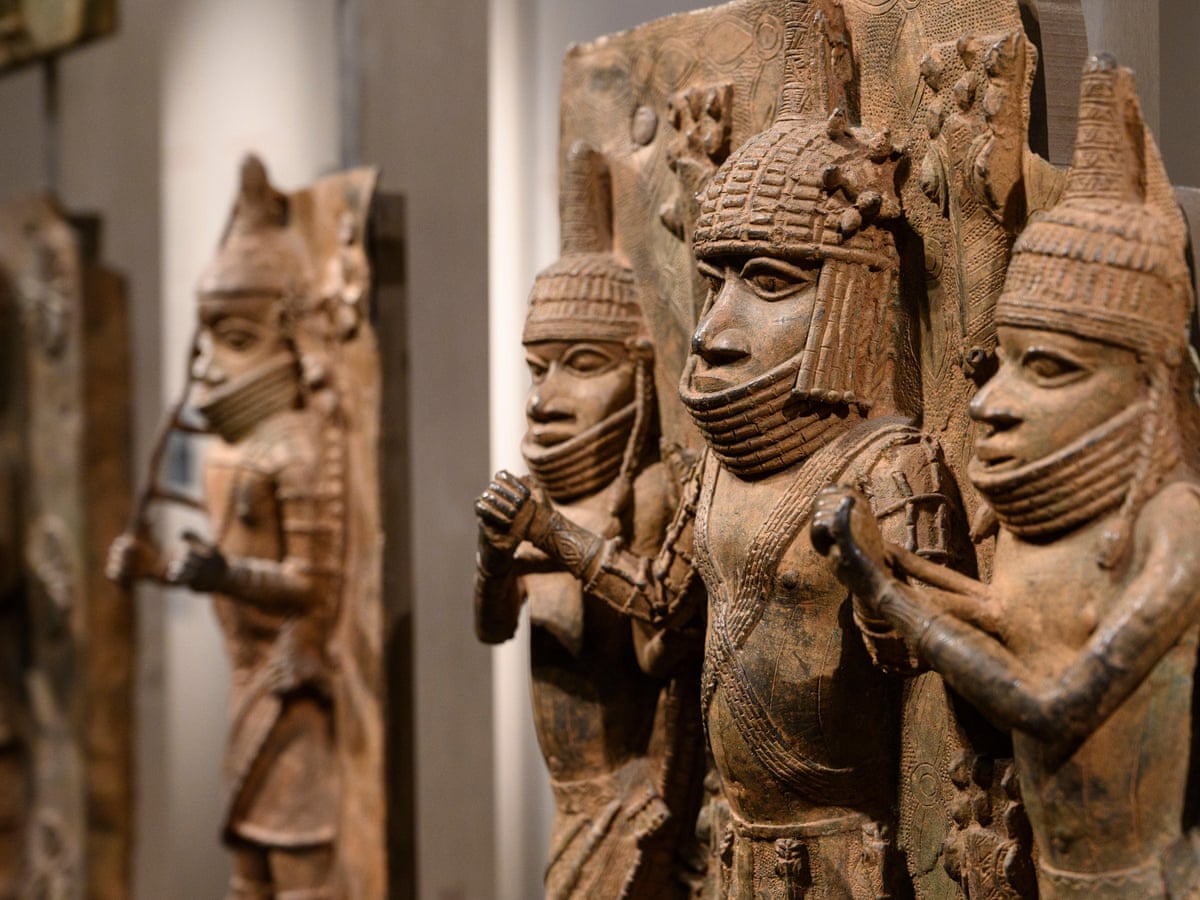
Writing Assignment: This is designed for you to think and reflect on what you're learning, how you're learning, and the significance of what you're learning. Thus, the assignment asks you to investigate the RISD Museum's return of its Benin bronze, Head of a King (Oba), in 2022, in relationship to Sarr, Savoy, Hicks, and Oliver's critiques and demands for restitution.
Discussion Board: The discussion prompt for this lesson asks you to consider new categories for permanent collections.
1 comments